Online Degrees UK 2026: Accreditation, Career Prospects & Future Trends

The educational landscape is in a constant state of flux, and nowhere is this more evident than in the rapid expansion and evolution of online degrees. The United Kingdom, a global leader in higher education, has embraced this shift with increasing vigour. As we look towards 2026, the prominence of UK Online Degrees is set to reach new heights, offering unparalleled flexibility and access to world-class education. This comprehensive guide will delve into the critical aspects of pursuing a UK Online Degree, focusing on accreditation, career prospects, and the technological innovations shaping this dynamic field. Understanding these elements is crucial for anyone considering this pathway, ensuring that their investment in education yields significant returns.
The Rise of UK Online Degrees: A 2026 Comparison of Accreditation and Career Prospects
The digital transformation has reshaped nearly every sector, and education is no exception. For decades, distance learning has been an option, but the technological advancements of the 21st century, coupled with global events, have propelled online education into the mainstream. In the UK, universities have responded by developing robust, high-quality online programmes that mirror the academic rigour of their on-campus counterparts. This has opened doors for a diverse demographic, including working professionals, individuals with caring responsibilities, and international students unable to relocate.
The appeal of UK Online Degrees lies in their inherent flexibility. Students can often study at their own pace, balancing academic commitments with personal and professional lives. This autonomy, however, comes with a responsibility to choose programmes wisely, paying close attention to factors like institutional reputation, course content, and crucially, accreditation. As we navigate towards 2026, the market for online degrees will become even more competitive, making informed decision-making paramount.
Understanding Accreditation for UK Online Degrees
Accreditation is the cornerstone of educational quality and recognition. For any degree, whether online or on-campus, accreditation signifies that a programme meets rigorous academic standards set by independent bodies. When considering a UK Online Degree, verifying its accreditation is not just important; it’s essential for ensuring the value and legitimacy of your qualification. Without proper accreditation, a degree may not be recognised by employers, professional bodies, or other educational institutions, severely limiting its utility.
Key Accreditation Bodies and Their Roles
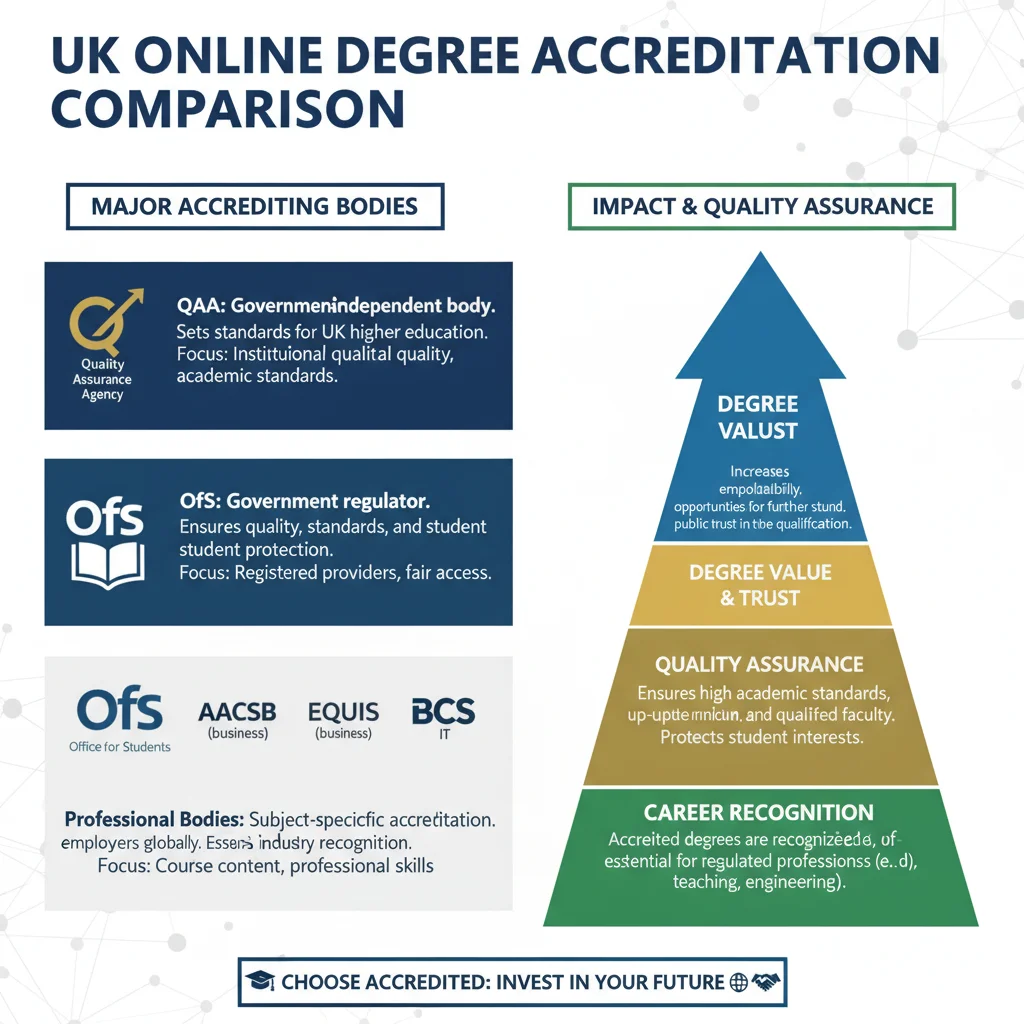
In the UK, the primary form of accreditation for universities is institutional accreditation, which means the university itself is recognised as a degree-awarding body. This is typically granted by a Royal Charter or an Act of Parliament. The Quality Assurance Agency for Higher Education (QAA) plays a vital role in safeguarding standards and improving the quality of UK higher education. While the QAA doesn’t ‘accredit’ individual courses in the way some international bodies might, its reviews and benchmarks ensure that UK universities meet expected standards, which in turn applies to their online offerings.
Beyond institutional accreditation, some specific professions or fields of study have their own professional accreditation bodies. For example, engineering degrees might be accredited by the Engineering Council, and law degrees by the Solicitors Regulation Authority (SRA) or the Bar Standards Board (BSB). When pursuing a UK Online Degree in a professional field, it is crucial to ensure that the programme holds the necessary professional accreditation to enable entry into that profession. This is particularly relevant for fields like medicine, nursing, teaching, and certain branches of engineering or finance, where professional licensure or membership is contingent upon completing an accredited programme.
By 2026, the transparency and accessibility of accreditation information for UK Online Degrees are expected to improve further, with universities making this information more prominent on their websites. Prospective students should always look for clear statements regarding the university’s degree-awarding powers and any relevant professional accreditations for their chosen programme. Contacting the university’s admissions office or the relevant professional body directly can provide additional reassurance.
Career Prospects with a UK Online Degree in 2026
One of the most pressing questions for prospective students is how a UK Online Degree will impact their career prospects. The good news is that by 2026, employers are increasingly recognising the value and legitimacy of online qualifications, especially those from reputable UK institutions. The skills developed through online learning – self-discipline, time management, digital literacy, and independent research – are highly valued in today’s workforce.
Employer Perceptions and Market Trends
Initially, there might have been some skepticism about online degrees, but this has largely dissipated. Employers are now more focused on the quality of the institution, the relevance of the degree content, and the skills of the graduate, rather than the mode of delivery. Many major corporations and public sector organisations actively recruit graduates with online degrees, understanding that these individuals often bring a unique blend of academic knowledge and practical, real-world experience gained while studying. The flexibility offered by UK Online Degrees often means students are able to continue working or gain relevant experience concurrently with their studies, making them highly attractive to employers upon graduation.
Furthermore, the global nature of online learning means that graduates of UK Online Degrees are often exposed to diverse perspectives and international collaboration, skills that are invaluable in an interconnected global economy. This exposure can broaden their horizons and make them more adaptable to different work environments and cultural contexts.
Sector-Specific Opportunities
Certain sectors are particularly receptive to online degree holders. Technology, digital marketing, healthcare management, education, and business administration are just a few examples where the demand for skilled professionals is high, and online qualifications are widely accepted. For instance, a Master’s in Data Science pursued online from a leading UK university can open doors to lucrative roles in tech companies worldwide. Similarly, an online MBA can significantly boost career progression for aspiring business leaders.
By 2026, we anticipate an even greater integration of online degree holders into traditional professional pathways. The growth of remote work and hybrid models across industries will further normalise the concept of a digitally-acquired education. The key for graduates of UK Online Degrees will be to effectively articulate the skills and experiences gained, showcasing how their online learning journey has prepared them for the demands of the modern workplace.
Technological Innovations Shaping Online Learning in the UK
The evolution of UK Online Degrees is inextricably linked to advancements in educational technology. The period leading up to 2026 will see even more sophisticated tools and platforms enhancing the online learning experience, making it more engaging, interactive, and effective.
Immersive Learning Experiences
Virtual Reality (VR) and Augmented Reality (AR) are poised to revolutionise online education. Imagine medical students practicing complex surgeries in a VR environment, or architecture students walking through their designs in AR. These immersive technologies can provide hands-on experience that was once thought impossible outside a physical campus. By 2026, we expect more UK Online Degrees, particularly in vocational and scientific fields, to incorporate these technologies, bridging the gap between theoretical knowledge and practical application.
AI-Powered Personalisation and Support
Artificial Intelligence (AI) is already being used to personalise learning paths, provide instant feedback, and identify areas where students might need additional support. AI-powered tutors, intelligent chatbots, and adaptive learning platforms can tailor content to individual student needs, ensuring a more efficient and effective learning journey. For students pursuing a UK Online Degree, this means a more customised educational experience, potentially leading to better academic outcomes and increased engagement.
Enhanced Collaboration Tools
Beyond basic video conferencing, new collaboration tools are emerging that facilitate more dynamic and interactive group work. Virtual whiteboards, shared digital workspaces, and sophisticated project management platforms allow students to collaborate seamlessly on projects, regardless of their geographical location. This fosters a sense of community and teamwork, replicating the collaborative environment of a physical classroom and preparing students for the collaborative nature of modern workplaces.
Choosing the Right UK Online Degree for You
With the proliferation of UK Online Degrees, making the right choice can seem daunting. Several factors should influence your decision to ensure the programme aligns with your academic goals, career aspirations, and personal circumstances.
Researching Institutions and Programmes
Start by researching reputable UK universities known for their strong academic programmes, both on-campus and online. Look at university rankings, but also delve deeper into specific department reputations. Crucially, scrutinise the programme content: does it cover the areas you are passionate about and that are relevant to your career goals? Read module descriptions, learning outcomes, and assessment methods carefully. Don’s forget to check the faculty profiles – who will be teaching you, and what are their areas of expertise?
Considering Flexibility and Learning Style
One of the primary advantages of UK Online Degrees is flexibility, but the degree of flexibility can vary. Some programmes are entirely asynchronous, allowing you to study at any time, while others might have scheduled live sessions. Consider your own learning style and availability. Are you self-motivated enough for a fully asynchronous course, or would you benefit from some structured live interaction? Ensure the programme’s structure aligns with your lifestyle and commitments.
Cost and Funding Opportunities
Tuition fees for UK Online Degrees can vary significantly. While online degrees often eliminate living costs associated with relocating, you still need to budget for tuition, materials, and potentially technology upgrades. Research scholarships, grants, and student loans specifically available for online learners. Many UK universities offer specific scholarships for international online students or those from underrepresented backgrounds. Don’t hesitate to contact the university’s financial aid office for detailed information.
Support Services for Online Students
A high-quality UK Online Degree programme will offer comprehensive support services for its online students. This includes academic advising, technical support, career services, library access, and mental health and wellbeing support. Before enrolling, inquire about the level of support provided. Access to these resources can significantly impact your success and overall experience as an online learner.

Challenges and How to Overcome Them
While the benefits of UK Online Degrees are numerous, prospective students should also be aware of potential challenges and strategies to overcome them. Awareness and preparation are key to a successful online learning journey.
Maintaining Motivation and Discipline
Studying online requires a high degree of self-motivation and discipline. Without the physical presence of a classroom, it can be easy to procrastinate or lose focus. Strategies to combat this include establishing a regular study schedule, setting clear goals, creating a dedicated study space, and regularly engaging with course materials and peers. Many online programmes incorporate regular deadlines and interactive elements to help students stay on track.
Technical Requirements and Digital Literacy
A stable internet connection, a reliable computer, and basic digital literacy skills are prerequisites for any UK Online Degree. While universities provide technical support, students should ensure they are comfortable navigating online learning platforms, using video conferencing tools, and managing digital files. Investing in good quality equipment and familiarising yourself with the necessary software before starting can prevent significant frustration down the line.
Networking and Community Building
One common concern about online learning is the potential for isolation. However, modern UK Online Degrees are designed to foster community. Participate actively in online discussion forums, virtual group projects, and any optional live sessions. Many universities also facilitate virtual networking events, alumni groups, and social media channels for their online students. Proactively engaging with your peers and faculty can enrich your learning experience and build valuable professional connections.
The Future Outlook for UK Online Degrees Beyond 2026
Looking beyond 2026, the trajectory for UK Online Degrees is one of continued growth, innovation, and integration into the broader higher education ecosystem. We can anticipate several key trends that will further shape this landscape.
Micro-credentials and Stackable Qualifications
The demand for flexible, bite-sized learning will likely lead to a surge in micro-credentials and stackable qualifications. These shorter, focused courses can be taken individually to upskill or reskill, or combined to form a full degree. This modular approach to UK Online Degrees will offer even greater flexibility and allow individuals to tailor their education precisely to their career needs, adapting quickly to evolving industry demands.
Global Collaboration and International Reach
UK universities already attract a significant international student body, and online degrees extend this reach globally without geographical barriers. We can expect more international collaborations between UK institutions and universities worldwide, leading to joint degrees and programmes that offer diverse perspectives and global recognition. This will further solidify the UK’s position as a leader in international higher education.
Lifelong Learning and Professional Development
The concept of lifelong learning is becoming increasingly critical in a rapidly changing job market. UK Online Degrees will play a pivotal role in enabling professionals to continually update their skills and knowledge throughout their careers. Universities will likely expand their offerings for executive education, professional development courses, and postgraduate diplomas, all delivered online, catering to the needs of a workforce that requires continuous learning to remain competitive.
Conclusion
The landscape of UK Online Degrees in 2026 is one of immense opportunity and innovation. With robust accreditation processes, increasingly positive employer perceptions, and cutting-edge technological advancements, online learning from UK institutions offers a credible and highly valuable pathway to achieving academic and career aspirations. For prospective students, the key lies in thorough research, understanding accreditation standards, evaluating career prospects, and choosing a programme that aligns with individual needs and goals.
As education continues its digital transformation, UK Online Degrees are not just an alternative; they are becoming a preferred choice for many, offering the flexibility, quality, and global recognition required to thrive in the modern world. By carefully considering the information presented in this guide, you can confidently embark on your online learning journey and unlock a world of possibilities for your future.